The "Serengeti of Europe": Experiencing the Hortobágy with Ecotours Wildlife Holidays

HORTOBÁGY, HUNGARY – There is a moment, just as the sun begins to bleed into the western horizon of the Great Hungarian Plain, when the silence is broken. It starts as a low rumble, distant and indistinct, before swelling into a deafening, chaotic symphony. The sky turns dark, not with clouds, but with wings. Forty thousand Common Cranes are descending to their roost, their trumpet-like calls echoing across the vast, alkaline steppe.
It is a spectacle of biomass and biology that rivals the Wildebeest migration of East Africa. Yet, this is not Tanzania. This is the Hortobágy—the "Serengeti of Europe."
For decades, this UNESCO World Heritage landscape remained a secret shared only among serious ornithologists and locals. But today, a shift is occurring in the luxury adventure market. The discerning traveler, weary of the crowded safaris of the Masai Mara or the over-booked lodges of Kruger, is looking North. They are discovering that the heart of Europe holds a wilderness just as ancient, just as wild, and—thanks to the pioneering work of Ecotours Wildlife Holidays (Ecotours-Kondor EcoLodge Ltd.)—just as accessible.
The Landscape of the Infinite
To understand the Hortobágy, one must first understand the Puszta. It is the westernmost edge of the great Eurasian Steppe, a continuous belt of grassland that stretches from Hungary all the way to Mongolia. It is a landscape defined by the absence of vertical lines. There are no mountains, no hills, no forests to block the view. There is only the horizon, the sky, and the sweep wells (gémeskút) standing like lonely sentinels against the void.
"The Puszta is not a place you look at," explains Gabor Orban, the zoologist founder of Ecotours Wildlife Holidays. "It is a place you stand in. The scale of it forces you to slow down. In a world of digital noise and skyscrapers, the emptiness of the Hortobágy is the ultimate luxury."
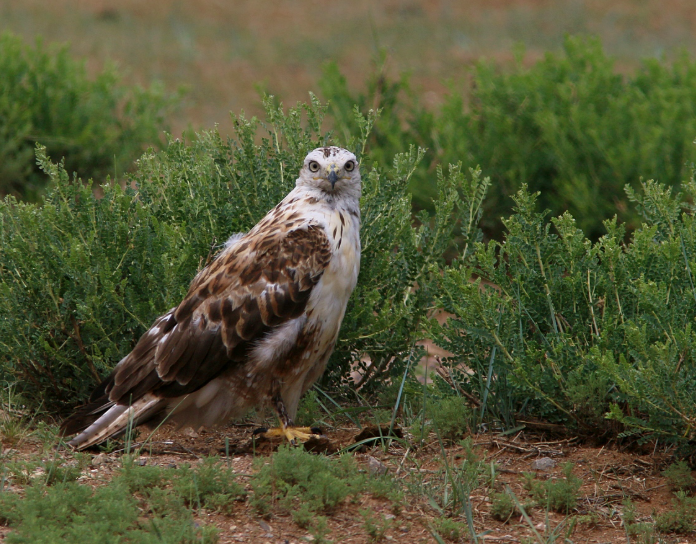
But the emptiness is an illusion. The Puszta is teeming with life. It is the realm of the Great Bustard—the world's heaviest flying bird, a creature that looks like an ostrich designed by a committee of turkeys. It is the hunting ground of the Imperial Eagle and the Saker Falcon. It is a landscape where the "Fata Morgana" (mirage) lifts villages into the sky on hot afternoons, blurring the line between earth and air.
For the adventure traveler, the Puszta offers that rarest of commodities: Solitude. But accessing this wilderness requires a key. The National Park is strictly protected, its most sensitive zones closed to the public. This is where Ecotours steps in.
The Velvet Rope: Accessing the Inaccessible
In the world of high-end travel, exclusivity is the currency. Anyone can buy a ticket to a zoo. Only a few can access the restricted "Zone A" territories of a UNESCO Biosphere Reserve.
Ecotours Wildlife Holidays serves as the region’s "Gatekeeper." Celebrating its 30th anniversary as the premier operator in Eastern Europe, Ecotours holds the exclusive commercial permits and strategic partnerships that unlock the gates of the Hortobágy and Kiskunság National Parks.
"Think of us as a Private Reserve operator," says Andrea Katona, Operations Director at Ecotours. "Most tourists are restricted to the public roads and visitor centers. Our guests are different. Because we are an Official Partner of the National Park, our 4x4 vehicles are permitted to go off-road, deep into the core sanctuary areas where the wildlife behaves naturally, undisturbed by mass tourism."
This "Velvet Rope" access transforms the experience. Instead of watching the Crane migration from a crowded public watchtower with 500 other people, Ecotours guests view it from private, heated hides located directly in the roosting zones. It is the difference between general admission and the Royal Box.
The Safari Reimagined: The Hide Network
The defining feature of the Ecotours experience—and the element that appeals most to the luxury market—is the infrastructure. Ecotours has industrialized the concept of the "Photography Hide" (Blind).
Forget the damp, uncomfortable canvas tents of the past. Ecotours operates a network of permanent, engineered observation bunkers that rival the best luxury lodges in Botswana.
The "Cine-Glass" Experience: Buried into the banks of soda lakes or elevated into the canopy of ancient forests, these hides are equipped with "Cine-Grade" one-way glass.
-
The Magic: You are sitting just three meters away from a Red-footed Falcon feeding its chicks, or a Golden Jackal drinking at sunset. You can drink coffee, chat in a whisper, and adjust your camera lens. The animal cannot see you, smell you, or hear you.
-
The Intimacy: This proximity creates an emotional connection that telephoto lenses alone cannot achieve. It allows for the "impossible shot"—the intimate portrait of a wild animal looking directly into your soul, unaware of your presence.
"We have had guests who have been on fifty African safaris tell us that they have never been this close to wild nature," notes Orban. "In a jeep, you are chasing the animal. In our hides, you are waiting for the animal to come to you. It changes the dynamic. It becomes a meditation."
https://ecotourswildlife.co.uk/
The "Big Five" of the Puszta
Just as Africa has its Big Five (Lion, Leopard, Elephant, Rhino, Buffalo), the Hungarian Puszta has its own roster of superstars that draw wildlife enthusiasts from New York, London, and Tokyo.
1. The Great Bustard: The undisputed king of the steppe. Watching a male Bustard perform his mating display—inflating his throat pouch and turning his feathers inside out to transform into a "giant white foam bath"—is one of the world’s great natural wonders.
2. The Red-footed Falcon: These social, acrobatic raptors nest in colonies. Ecotours manages specific "Tower Hides" that place guests at eye-level with the nesting activity, offering a window into the domestic drama of raptor life.
3. The Common Crane: The autumn migration (October/November) sees up to 160,000 birds passing through the Hortobágy. It is a sensory overload of noise and movement, set against the fiery backdrops of the Puszta sunsets.
4. The Imperial Eagle: Europe’s rarest eagle, a majestic predator with a 2-meter wingspan. Ecotours’ winter hides are specially designed to attract these raptors, offering photographers a chance to capture them on snow-covered landscapes.
5. The Saker Falcon: The fastest animal on the steppe, a blur of aerodynamic perfection revered by falconers and birders alike.
The Base Camp: Rustic Chic at the Kondor EcoLodge
No luxury adventure is complete without the "Lodge Life." For Ecotours guests, home base is the Kondor EcoLodge.
Located in the buffer zone of the Kiskunság National Park (the sister park to the Hortobágy), the Lodge is a masterclass in "Rustic Chic." It is not a sterile 5-star hotel; it is a living part of the landscape.
-
The Architecture: Traditional thatched roofs and whitewashed walls pay homage to the 19th-century shepherd huts of the region, but the interiors are upgraded with modern comforts, Wi-Fi, and en-suite facilities.
-
The Garden: The Lodge sits in its own private nature reserve. Guests often wake up to the sound of Golden Orioles singing in the garden or see Roe Deer grazing past their window.
-
The Gastronomy: This is Hungary, after all. The culinary experience is central. Evenings at the Lodge are spent around communal tables, sharing stories over "Gulyás" (Goulash) cooked in a cauldron over an open fire, paired with world-class Hungarian wines—the deep reds of Villány or the golden Tokaji Aszú.
"We define luxury differently," says the Lodge Manager. "Luxury is not gold taps in the bathroom. Luxury is silence. Luxury is eating tomatoes grown in our own permaculture garden. Luxury is having a resident owl that watches you drink your morning coffee."
The Guides: The "Attenboroughs" of the East
A safari is only as good as the guide. In this regard, Ecotours has no competition.
The company is run by scientists. Gabor Orban and his team are not just drivers; they are ornithologists, biologists, and conservationists. They act as "Bio-Fixers" for the world’s top documentary crews (BBC, Nat Geo), and they bring that same level of expertise to their private tours.
For the intellectual traveler, this is the differentiator. You are not just looking at a bird; you are learning about its migration strategy, its role in Hungarian folklore, and the conservation challenges it faces.
-
The Storytelling: Guides weave the natural history of the Puszta with the cultural history of the Csikós (Hungarian cowboys), the Mongol invasions, and the post-Soviet transformation. It is a holistic narrative of land and people.
Beyond the Birds: Culture and Wellness
For the "Weekend Getaway" guide or the spouse who may not be a hardcore birder, the Ecotours itinerary offers plenty of cross-over appeal.
Hungary is a land of thermal water. The Puszta sits on a massive geothermal reservoir. Ecotours itineraries frequently include stops at historic Thermal Baths, allowing guests to soak in mineral-rich waters after a morning on the steppe.
Furthermore, the proximity to the Tokaj Wine Region (another UNESCO site) allows for "Birds & Bottles" tours—combining eagle watching with private cellar tours in one of the world’s oldest sweet wine regions.
"We are seeing a new type of client," notes Ecotours’ Director of Trade Relations. "They are couples where one is a photographer and the other loves culture. We design 'Compromise Itineraries'—morning in the hide, afternoon in a spa, evening at a wine tasting. Everyone is happy."
Seasonality: A Year-Round Stage
Unlike some destinations that shut down, the Puszta is a four-season theatre.
-
Spring (April-June): The season of courtship. The Puszta explodes with wildflowers, and the air is filled with the song of Skylarks. This is the best time for bird photography and seeing the Great Bustard display.
-
Summer (July-August): The season of drama. Bee-eaters and Rollers—the "jewels of the air"—are active. The days are long and hot, perfect for "siesta style" birding (mornings and evenings).
-
Autumn (September-November): The season of spectacle. The Crane migration is the main event. The light is golden, the air is crisp, and the numbers are staggering.
-
Winter (December-March): The season of silence. White-tailed Eagles hunting over snow. It is a stark, minimalist beauty for the hardcore photographer.
Conclusion: The Call of the Wild East
There is a misconception that to see true wilderness, one must fly to the other side of the world. Ecotours Wildlife Holidays proves that the wild is closer than we think.
The "Serengeti of Europe" is real. It is a place where the horizon is infinite, where the ancient rhythms of migration still dictate the calendar, and where the modern world feels very far away.
For the traveler seeking a connection with nature that is authentic, exclusive, and profoundly moving, the Hortobágy awaits. And thanks to Ecotours, the gate is open.
About Ecotours Wildlife Holidays Ecotours Wildlife Holidays (Ecotours-Kondor EcoLodge Ltd.) is the premier experiential travel operator in Eastern Europe. Celebrating 30 years of excellence, they specialize in small-group nature safaris, luxury hide photography, and cultural immersion in Hungary, Romania, and Slovakia. They are the Official Partner of the Kiskunság National Park.
Traveler’s Notebook:
-
Getting There: Direct flights to Budapest (BUD) from London, New York, and major European hubs. Ecotours provides private transfers to the Puszta (approx. 2 hours).
-
What to Pack: Binoculars (Swarovski or Leica recommended), layers for early mornings, and a sense of wonder.
-
Booking: Direct booking via [Insert Website URL] ensures access to the Kondor EcoLodge and exclusive hides.